Introduction How AI Is Changing Education in 2026
Artificial Intelligence (AI) is transforming nearly every aspect of modern life, and education is no exception. In 2026, AI has become one of the most influential technologies in schools, colleges, universities, and online learning platforms. From personalized learning experiences to automated grading systems, AI is helping students learn more effectively and teachers work more efficiently.
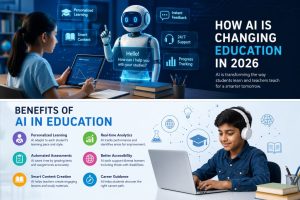
As technology continues to evolve, understanding the impact of AI on education is essential for students, parents, teachers, and policymakers. This article explores how AI is changing education in 2026, its benefits, challenges, and what the future may hold.
What Is Artificial Intelligence?
Artificial Intelligence refers to computer systems designed to perform tasks that normally require human intelligence. These tasks include learning, problem-solving, language understanding, decision-making, and recognizing patterns.
In education, AI-powered tools can analyze student performance, provide personalized recommendations, answer questions, create study materials, and even assist teachers in managing classrooms.
Personalized Learning for Every Student
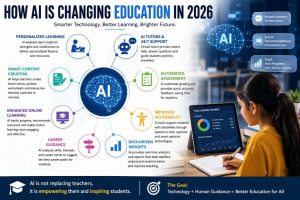
One of the most significant contributions of AI in education is personalized learning. Traditional classrooms often follow a one-size-fits-all approach. However, students learn at different speeds and have different strengths and weaknesses. AI can analyze a student’s performance and create customized learning paths.
For example:
- Advanced students can receive more challenging assignments.
- Students struggling with a topic can receive additional explanations and practice exercises.
- Learning materials can be adjusted according to individual needs.
- This personalized approach helps students learn more effectively and improves academic outcomes.
AI-Powered Tutors
AI tutors are becoming increasingly popular in 2026. These virtual assistants are available 24/7 and can help students with homework, exam preparation, and concept clarification.
Benefits of AI tutors include:
- Instant responses to questions
- Personalized explanations
- Continuous availability
- Support for multiple subjects
- Students can receive guidance whenever they need it without waiting for classroom hours or tutoring sessions.
Smart Content Creation
AI is helping educators create educational content more quickly and efficiently.
- Teachers can use AI tools to:
- Generate quizzes and tests
- Create lesson plans
- Develop worksheets
- Produce study guides
- Design interactive learning materials
This reduces administrative workload and allows teachers to focus more on teaching and student engagement.
Automated Assessment and Grading
Grading assignments can consume a significant amount of time for educators. AI-powered systems can automatically evaluate:
- Multiple-choice exams
- Objective assessments
- Short-answer questions
- Coding assignments
Automated grading provides faster feedback to students and helps teachers identify areas where students may need additional support.
Enhanced Online Learning
Online education has expanded dramatically over recent years. AI is making online learning more effective by:
- Tracking student progress
- Recommending learning resources
- Identifying learning gaps
- Providing real-time assistance
Many online platforms now use AI algorithms to recommend courses based on a learner’s interests and career goals.
Language Learning and Translation
AI-powered language tools are helping students learn new languages more efficiently.
- Modern AI systems can:
- Correct pronunciation
- Translate text instantly
- Provide grammar suggestions
- Offer conversational practice
Students can practice languages independently and receive immediate feedback.
Supporting Teachers
Contrary to fears that AI will replace teachers, the technology is primarily serving as a support tool.
- AI helps teachers by:
- Reducing administrative tasks
- Monitoring student performance
- Identifying at-risk students
- Generating reports and analytics
This allows educators to spend more time mentoring, motivating, and supporting students.
Improved Accessibility
AI is making education more inclusive for students with disabilities.
Examples include:
- Speech-to-text technology
- Text-to-speech tools
- Real-time captioning
- Visual recognition assistance
- Personalized accessibility features
These innovations help ensure equal learning opportunities for all students.
AI and Career Guidance
Students often struggle with choosing suitable career paths. AI-powered career guidance platforms analyze:
- Academic performance
- Skills and interests
- Industry trends
- Employment opportunities
Based on this information, AI can suggest career options and educational pathways aligned with a student’s strengths.
Challenges of AI in Education
Despite its benefits, AI also presents several challenges.
Privacy Concerns
Educational platforms collect large amounts of student data. Ensuring data privacy and security remains a major concern.
Overdependence on Technology
Excessive reliance on AI tools may reduce critical thinking and problem-solving skills if students use technology without understanding concepts.
Digital Divide
Not all students have equal access to advanced technology. This can create educational inequalities.
Accuracy Issues
AI systems can sometimes provide incorrect or misleading information. Human oversight remains essential.
The Future of AI in Education
The future of AI in education looks promising. Experts predict that future classrooms will feature:
- Highly personalized learning environments
- Advanced virtual tutors
- Immersive AI-powered simulations
- Intelligent assessment systems
- Real-time learning analytics
As AI continues to evolve, it will likely become an indispensable partner in the learning process.
Conclusion, How AI Is Changing Education in 2026
Artificial Intelligence is revolutionizing education in 2026 by making learning more personalized, accessible, and efficient. AI-powered tools are helping students achieve better results while allowing teachers to focus on meaningful educational interactions.
Although challenges such as privacy concerns and technological dependence must be addressed, the benefits of AI in education are substantial. When used responsibly, AI has the potential to create a more effective and inclusive educational system for future generations.
The future of education is not about replacing teachers with machines; it is about empowering teachers and students with intelligent tools that enhance learning and unlock human potential.